Tell us about the job
Takes about a minute. No obligation.
The compressor in a central AC unit starts and stops repeatedly through every cooling cycle, and all of that cycling adds up against a limited window. Homes in Allegany County, MD run cooling about two months a year, from July through August. A contactor that has been opening and closing under full summer load, and a condenser fan motor that ran every time the compressor did, are the first things a contractor pulls for inspection when the system stops cooling. Capacitors and contactors tend to give out here on a hot afternoon in the middle of that stretch, not gradually over the fall.
Ductwork sized for earlier equipment, service histories that stretch back further than most records, and parts that sit at the edge of what manufacturers still supply: these are what a contractor opens up to in a significant share of houses here. Half the homes in Allegany County, Maryland were built in 1959 or earlier (2020-2024 ACS 5-year). A system still cooling a house that old was either retrofitted at some point or replaced at least once, which means the repair scope depends heavily on what generation of components is actually inside the cabinet, and whether those components can still be sourced. When a part is discontinued, the contractor's finding changes the job from a straightforward fix to a decision about the system's future.
The Parts of a Central AC a Contractor Checks First
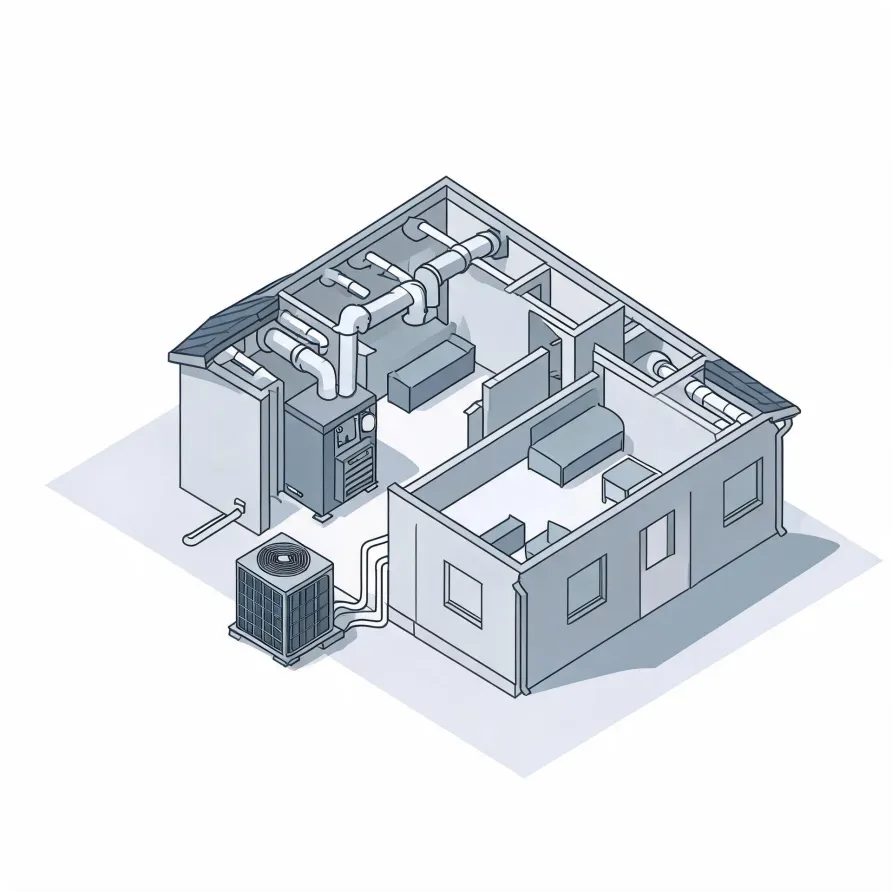
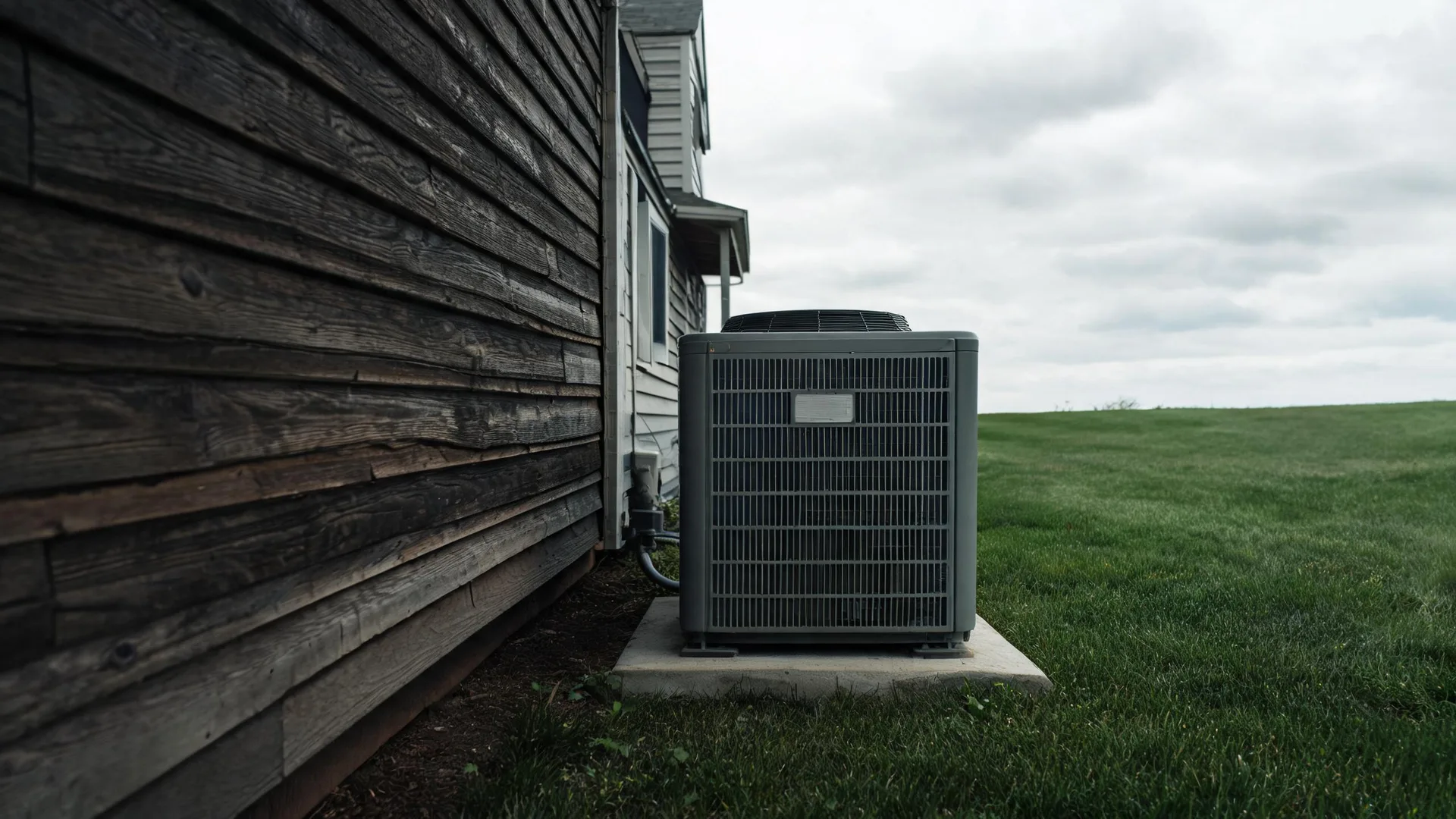
The outdoor condenser unit sits outside the house, usually on a concrete pad beside the foundation, and it carries the compressor and the condenser coil. Both are common starting points when a system stops cooling. The compressor pressurizes the refrigerant; the condenser coil sheds heat to the outside air. When either fails, the whole system feels it.
Inside the house, the air handler or furnace cabinet holds the evaporator coil and the blower fan. The evaporator coil pulls heat out of indoor air, and the blower pushes that air through the house. A refrigerant line set runs between the two units, and the thermostat on the wall tells the whole system when to run and when to stop.
The drawing shows a typical layout, and a licensed contractor determines what applies to your specific system and home.
Get matched in Allegany CountyAllegany County, by the numbers
169 severe weather events were recorded in Allegany County, Maryland between 2015 and 2024.
NOAA National Centers for Environmental Information, Storm Events Database, bulk CSV export, events 2015-01-01 through 2024-12-31.Half the homes in Allegany County, Maryland were built in 1959 or earlier (2020-2024 ACS 5-year).
U.S. Census Bureau, 2020-2024 American Community Survey 5-Year EstimatesAllegany County, Maryland holds 32,720 housing units (2020-2024 ACS 5-year).
U.S. Census Bureau, 2020-2024 American Community Survey 5-Year EstimatesOwners occupy 70.7% of the occupied homes in Allegany County, Maryland (2020-2024 ACS 5-year).
U.S. Census Bureau, 2020-2024 American Community Survey 5-Year EstimatesRules & Standards Governing Central AC Repair in Allegany County, Maryland9 sourced rules and standards
What Happens When the Contractor Arrives
Split-system central air conditioners rated below 45,000 Btu/h manufactured on or after January 1, 2023 must meet a federal minimum of 13.4 SEER2.
Split-system central air conditioners rated at or above 45,000 Btu/h manufactured on or after January 1, 2023 must meet a federal minimum of 13.4 SEER2.
Split-system central air conditioners manufactured between January 1, 2015 and December 31, 2022 had to meet 13 SEER, the metric that preceded SEER2.
Single-package central air conditioners manufactured on or after January 1, 2023 must meet a federal minimum of 13.4 SEER2.
Space-constrained central air conditioners manufactured on or after January 1, 2023 must meet a federal minimum of 11.7 SEER2.
Federal efficiency standards for split-system central air conditioners and heat pumps are set on each certified combination of outdoor unit and indoor coil rather than on the outdoor unit alone.
Residential and light commercial air conditioning and heat pump systems assembled in the field, including mini-splits and unitary systems, may not be installed on or after January 1, 2025 using a refrigerant with a global warming potential above 700.
A field-assembled system whose specified components were all manufactured or imported before January 1, 2025 carries no installation compliance date under the refrigerant restrictions and may still be installed.
Licensing and Legal Requirements in Allegany County, Maryland
Maryland requires a state licence before an individual provides, or assists in providing, heating, ventilation, air-conditioning or refrigeration services.
Severe Weather Events in Allegany County
Extreme weather puts stress on central AC systems, and that stress compounds over time into the kind of wear that ends in a repair call. How often that weather arrives in Allegany County shapes how hard the equipment here works and how much a local contractor sees.
169 severe weather events, 2015–2024. Source: NOAA National Centers for Environmental Information, Storm Events Database.