Why your AC smells like burning in Maryland

Step 1 of 3: Equipment

Why does my AC smell like something burning?

A burning smell from an AC during a Maryland summer is not something to wait out. With how sticky it gets here and how much the system runs to keep the house livable, a smell like that usually means something is already wrong with a part, not just dust burning off.

It's usually a motor or electrical part overheating

A burning smell most often points to the blower motor, a failing capacitor, or wiring that's overheating somewhere in the unit. These parts carry a real electrical load, and when one starts to go bad, it runs hotter than it should and that heat gives off a smell before the part fails outright. With Maryland summers keeping the system running hard for months, those parts get worked harder too, and a strained one tends to show it sooner rather than later. A burning smell is different from a musty one. Musty usually means moisture in the ducts. Burning means electrical, and it's worth shutting the system off until it's looked at rather than running it and hoping the smell goes away on its own.

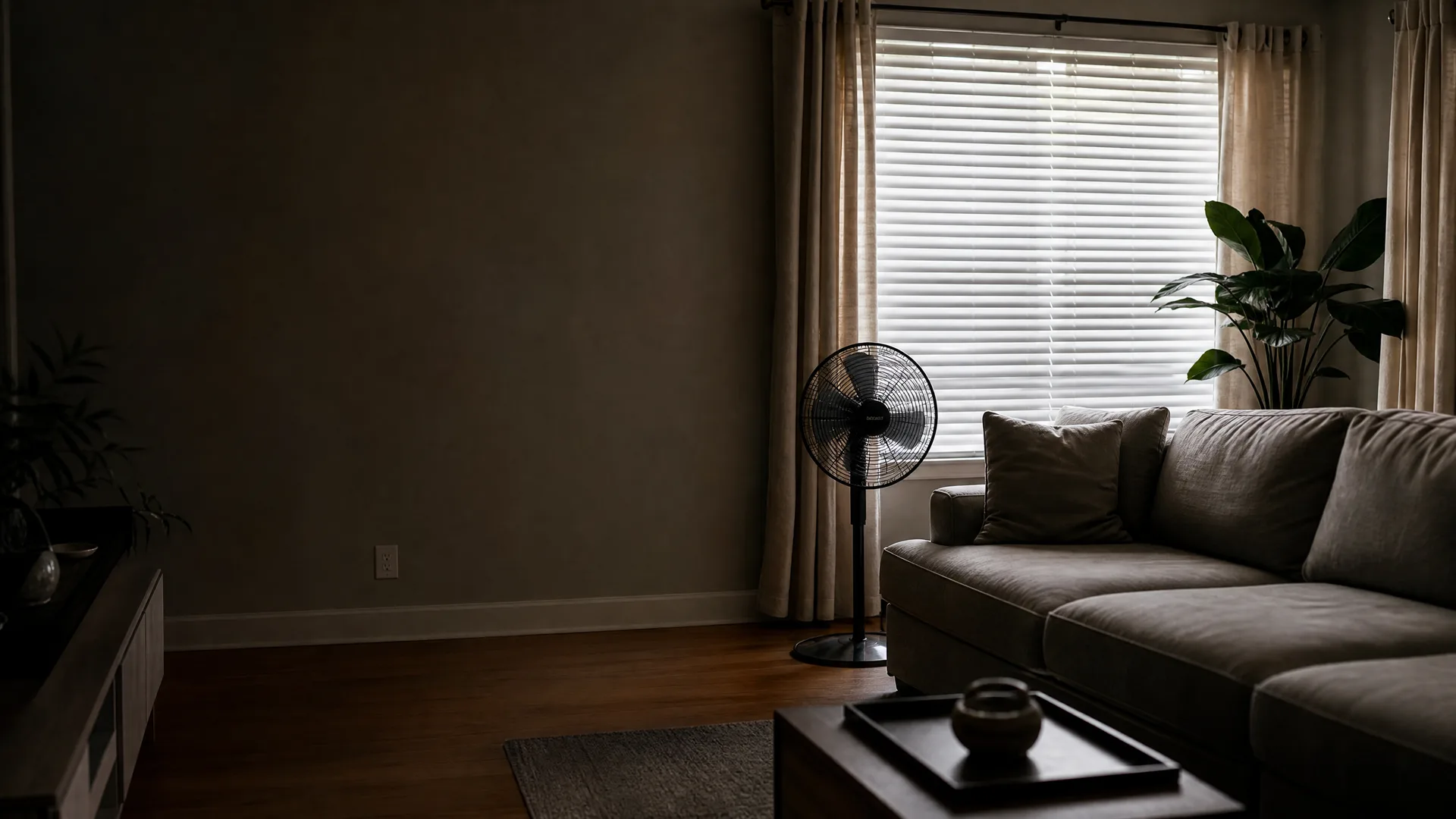
A dimly lit living room with a gray sectional sofa, a standing pedestal fan, a curtained window with blinds, a potted broad-leaved plant, a wooden coffee table with a tray and lidded jar, and a rug on dark wood flooring.

Two in the afternoon and the blinds are drawn tight against the sun. You've got the floor fan going next to the couch, pointed at the kids stretched out there trying to stay cool. Outside it's the kind of thick Maryland heat that makes the window glass warm to the touch. Then you catch it, faint at first under the fan noise, a hot, electrical smell drifting out from the hallway vent. You get up and check the thermostat, like that'll tell you anything. The unit's still running, the air still coming out cold. But that smell doesn't belong in your living room, not with everyone sitting right here under the vent.

Run It or Shut It Off

Keep running it

  • If the smell is a light dust burn-off after the AC sat idle, it usually clears within an hour and does not come back.
  • Running it anyway on a hot day can push a failing motor or stressed wire further, turning a small fix into a bigger one.
  • A rubbery or acrid smell means something is overheating right now, and continued runtime adds more heat to whatever is already failing.
  • If the smell carries any hint of rotten egg, that is not the AC at all and the unit should be shut off immediately.
  • Letting it run while you wait on a repair call means the house stays cool, but it's a bet on how much longer that part has left.

Shut it off now

  • Cutting power at the thermostat or breaker stops the heat source from building further damage to the coil, motor, or wiring behind it.
  • A few hours without AC in a Maryland August is uncomfortable, but it buys time without risking a bigger repair bill later.
  • If the smell was electrical, shutting it off removes the one thing feeding that risk until a contractor can look at it.
  • Fans and open windows in the evening can take the edge off the heat while the system sits off.
  • Shutting it down means the house loses its cooling for a stretch, which matters most for anyone home all day with kids or older family members.
A gray outdoor air conditioner condenser unit sits on a concrete pad beside a house with horizontal lap siding, with conduit and an electrical disconnect box on the wall, dark mulch and a shrub to the left, and a concrete walkway in the foreground.

What a normal setup looks like

No smell at all is the baseline. The unit sits on its pad, lines and conduit running into the wall, grilles clean enough that air moves through them the way it should. Nothing burning, nothing you can smell from the yard.

An outdoor air conditioning condenser unit on a concrete pad beside a house with horizontal lap siding, with a shrub and mulch bed to the left and conduit and a small electrical box on the wall to the right.

What trouble looks like from the outside

Dirt caked into the metal grilles cuts off airflow around the coil and makes the compressor work harder in the heat. Check where the lines meet the disconnect box on the siding too. Scorch marks or a burnt smell right there usually point to a wiring problem, not the refrigerant.

A woman with long wavy brown hair in a grey ribbed sweater sits on a couch indoors, looking toward a window, with a potted palm-like plant and fireplace behind her.
A woman with long brown hair wearing a green V-neck top and beige cardigan sits on a light sofa, looking off to the side, with a dining table, lamp and framed picture in the background.
A woman with long dark hair in a cream knit sweater sits on a beige sofa indoors, looking toward a bright window with a houseplant and framed picture in the background.
A woman with long dark hair in a green knit sweater sits on a couch indoors, smiling and looking toward a window with a blurred room behind her.

The right pro for this job

A burning smell is the kind of thing you notice and then have to decide what to do about, usually while everyone in the house is already hot and tired of waiting on relief. Maryland summers don't give the system a break long enough for a bad part to just work itself out. Electricity here isn't cheap, and a motor or wire that's struggling is often pulling harder and costing more while it fails. The safe move is having someone look at it before you run it again, not after. Once you send the request, you're not the one calling around trying to find somebody available this week. That part is off your plate. You still have a house to keep cool and a family inside it, and that's enough to manage on a day like this.

Where the Smell Starts

  • A burning dust smell usually comes from the coil or blower housing where dust settles when the unit has been off.
  • An electrical or plastic burning smell often traces to the blower motor windings or a wire insulation that has started to melt.
  • A hot, acrid smell can mean the capacitor is failing and arcing inside its casing as it tries to start the motor.
  • The contactor, a small switch that sends power to the outdoor unit, can pit and burn with heavy use and give off a sharp smell.
  • A burning rubber smell sometimes points to a fan belt or motor mount rubbing, though most home systems here run belt-free.
  • If the smell comes with a tripped breaker, the wiring or motor has likely already drawn more current than it should.

Every part in the system carries current or moves air, and each one fails in its own way. The coil and blower housing collect dust when the unit sits idle between cool spells, and that dust burns off fast when the blower kicks back on, which is why some burning smells clear on their own. A real electrical smell is different. It means something inside is heating up past where it should. The blower motor has windings of coated copper wire, and when that coating breaks down the plastic smell that comes off it is sharp and does not fade. The capacitor sits near the motor and gives it the jolt it needs to start. When it is failing, it can arc inside its own casing, and that arcing smell is hot and acrid, not dusty. The contactor is a small switch that sends power out to the compressor and fan every time the thermostat calls for cooling, and in a Maryland summer that can mean dozens of cycles a day. All that switching wears the contacts down until they pit and scorch. A belt rubbing is rare since most home AC units run belt-free, with the motor turning the fan directly, so a rubber smell more often means a motor mount or wire insulation touching something hot. A tripped breaker alongside any of these smells means the current draw already went past normal.

A gray outdoor air conditioning condenser unit on a concrete pad beside a house with horizontal lap siding and a stone veneer base, with a disconnect box and conduit on the wall, mulch bed and shrub to the right, and mowed grass in the foreground.
Clean grilles, clear airflow, and nothing in the air but cool air.
An outdoor air conditioner condenser unit on a gray composite pad beside a house with horizontal siding, a concrete foundation, a basement window, and a conduit and disconnect box on the wall.
Dust and grime caked across the cabinet mesh choke airflow and let heat build up around the wiring inside.
A single-story house with gray vinyl siding, dark shingled gable roofs, and white-trimmed windows, set behind a partly dry green lawn under a clear blue sky.

A Maryland summer carries a dew point around 64°F on average across June, July and August, per NOAA climate records. That's heavy, damp air, the kind that makes your skin feel wet standing still. Your AC has to pull more moisture out of that air to keep the house comfortable, which means longer run times and a system that rarely gets to shut off and cool down. The motor and wiring run hotter for more hours of the day. If something inside is already stressed, a failing motor winding or a wire insulation starting to go, that extra strain is what pushes it from a faint smell to one you can't ignore.

NASA POWER T2MDEW county cells weighted by homes

An older woman with gray hair in a bun and glasses, wearing a beige knit sweater, smiles while looking to the side in a warmly lit kitchen, with a loaf of bread on the counter in the foreground and a snowy scene outside the window.
A woman with her hair in a bun holds a sleeping young child against her chest, both wrapped in a textured beige knit blanket on a sofa in a dimly lit room with a lamp, framed picture, and bookshelf behind them.
  1. The AC draws in warm, humid air through the return vents.

  2. The blower motor pushes that air across the evaporator coil.

  3. A failing part overheats, giving off the smell before it fails outright.

  4. Air keeps moving through the ducts, carrying the smell into every room.

Power costs 19.53 cents per kilowatt-hour statewide

At 19.53 cents per kilowatt-hour, a struggling motor or blower running longer than it should costs you with every hour it keeps going. A unit forcing warm, sticky air through a failing part isn't working efficiently, and that shows up on the bill before the part gives out completely.

EIA-861 2025 statewide residential average

A burning smell from your AC means a part is failing somewhere between the coil and the blower, and Maryland's heat won't let it wait. Running it another day in this humidity just pushes a strained motor or a melting wire closer to the point where it quits for good, usually on the afternoon you need it most. Once you send the form, you're done hunting for who to call and done wondering if it's serious. A contractor who knows these units gets matched to your situation and reaches out to you directly. Whatever is behind that smell, dust burning off, a failing motor, a wire losing its insulation, it gets looked at by someone who can tell you plainly what's wrong and what it needs. You don't have to diagnose it yourself or keep running the system to see if it gets worse. That part is no longer yours to carry.

Sunlight falls across a beige upholstered sofa with a textured woven cushion and a chunky knit throw, beside a dark wood cabinet holding a ceramic vase with green leafy branches, near a white-framed window.
A sunlit corner of a room with a wooden side table holding a ceramic vase of green foliage and a wooden bowl, beside a light upholstered sofa with a knit throw and rust-colored pillow, with window shadows cast on a beige wall.
A sunlit room corner with beige walls, a white-framed window with sheer cream curtain, wood floor with a light rug, and a woven basket holding a knit blanket.
A beige ceramic vase holding a leafy green branch sits on a wooden cabinet in a corner, with sunlight through a sheer curtain casting leaf shadows on the wall.
A grey upholstered sofa with a rust-orange velvet cushion and a textured throw sits beside a window with linen curtains, next to a wooden side table holding a pale ceramic vase of olive branches.

Matched to your air conditioner job

Get the air conditioner repair search off your mind today.

Hand off my repair

It costs nothing to send, and you don't have to hire anyone.