Tell us about the job
Takes about a minute. No obligation.
A central AC compressor spends most of the year standing still in Queen Anne's County, and that idle time is where problems start. Homes in Queen Anne's County, MD run cooling about three months a year, from June through August. Contactors corrode, capacitors weaken, and refrigerant connections loosen over the long off-season without load to reveal any of it. A contractor called out on the first genuinely hot day in June is often tracing a fault that formed months earlier, not one the heat caused.
Ductwork laid in for an earlier generation of central AC rarely matches the system that has since replaced it. Coil placements shift, airflow paths get rerouted, and what a contractor finds once the cabinet is open reflects those accumulated changes rather than any single original design. Half the homes in Queen Anne's County, Maryland were built in 1990 or earlier (2020-2024 ACS 5-year). That history shapes what a repair turns into: a technician tracing a fault in this county is also reading what successive equipment swaps left behind in the plenum and the branch runs, and the repair scope follows from that, not from the model number on the unit.
The Parts of a Central AC a Contractor Checks First
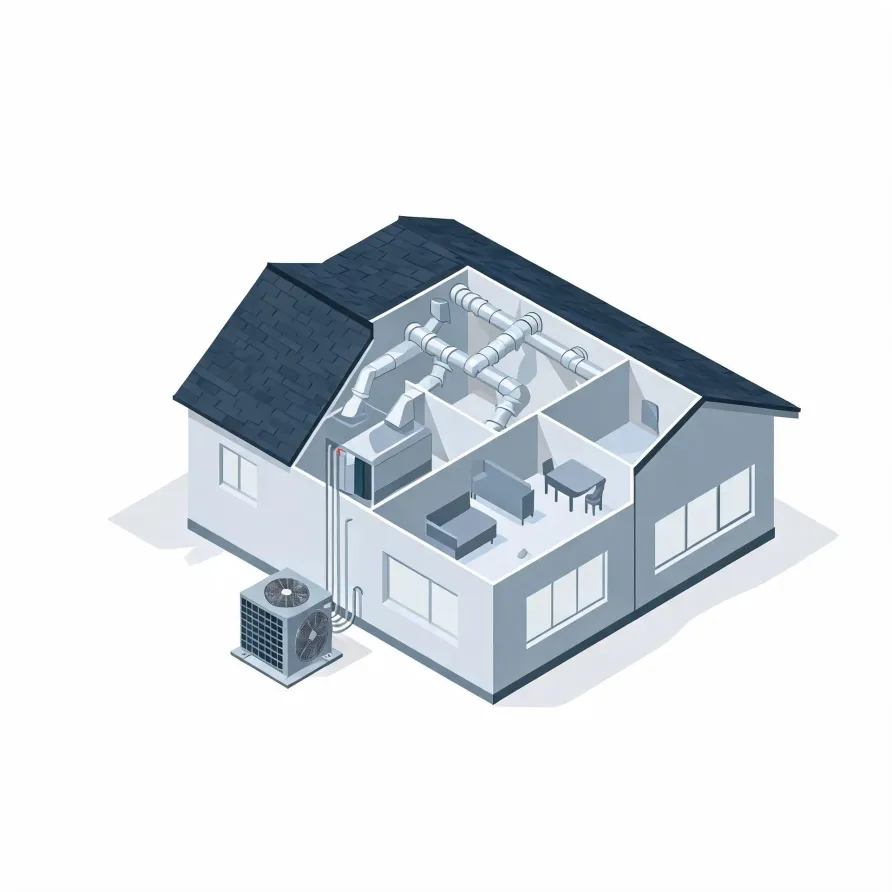
The outdoor condenser unit sits outside the house, usually on a concrete pad beside the foundation, and it carries the compressor and condenser coil. These are the pieces a contractor reaches first when a system stops cooling. The compressor is the heart of the refrigerant circuit, and the condenser coil sheds heat to the outside air.
Inside the house, the air handler holds the evaporator coil and the blower fan. The evaporator coil pulls heat out of indoor air, and the blower pushes that air through the home. A refrigerant line set runs between the two units, and the thermostat on the wall is the control point a contractor checks alongside the mechanical parts.
The drawing shows the general layout of a central AC system, and a licensed contractor determines which components apply and what condition they are in for your particular home.
Get matched in Queen Anne's CountyQueen Anne's County by the Numbers
132 severe weather events were recorded in Queen Anne's County, Maryland between 2015 and 2024.
NOAA National Centers for Environmental Information, Storm Events Database, bulk CSV export, events 2015-01-01 through 2024-12-31.Half the homes in Queen Anne's County, Maryland were built in 1990 or earlier (2020-2024 ACS 5-year).
U.S. Census Bureau, 2020-2024 American Community Survey 5-Year EstimatesQueen Anne's County, Maryland holds 22,038 housing units (2020-2024 ACS 5-year).
U.S. Census Bureau, 2020-2024 American Community Survey 5-Year EstimatesOwners occupy 82.9% of the occupied homes in Queen Anne's County, Maryland (2020-2024 ACS 5-year).
U.S. Census Bureau, 2020-2024 American Community Survey 5-Year EstimatesCodes & Standards Governing Central AC Repair in Queen Anne's County, Maryland9 sourced rules and standards
What Happens When a Contractor Comes Out
Split-system central air conditioners rated below 45,000 Btu/h manufactured on or after January 1, 2023 must meet a federal minimum of 13.4 SEER2.
Split-system central air conditioners rated at or above 45,000 Btu/h manufactured on or after January 1, 2023 must meet a federal minimum of 13.4 SEER2.
Split-system central air conditioners manufactured between January 1, 2015 and December 31, 2022 had to meet 13 SEER, the metric that preceded SEER2.
Single-package central air conditioners manufactured on or after January 1, 2023 must meet a federal minimum of 13.4 SEER2.
Space-constrained central air conditioners manufactured on or after January 1, 2023 must meet a federal minimum of 11.7 SEER2.
Federal efficiency standards for split-system central air conditioners and heat pumps are set on each certified combination of outdoor unit and indoor coil rather than on the outdoor unit alone.
Residential and light commercial air conditioning and heat pump systems assembled in the field, including mini-splits and unitary systems, may not be installed on or after January 1, 2025 using a refrigerant with a global warming potential above 700.
A field-assembled system whose specified components were all manufactured or imported before January 1, 2025 carries no installation compliance date under the refrigerant restrictions and may still be installed.
Licensing and Legal Requirements in Queen Anne's County, Maryland
Maryland requires a state licence before an individual provides, or assists in providing, heating, ventilation, air-conditioning or refrigeration services.
Severe Weather Events in Queen Anne's County
Weather puts real stress on cooling equipment. Each event recorded here represents the kind of load that accelerates wear and pushes systems toward failure, which makes the repair picture in Queen Anne's County different from somewhere with a milder record.
132 severe weather events, 2015–2024. Source: NOAA National Centers for Environmental Information, Storm Events Database.